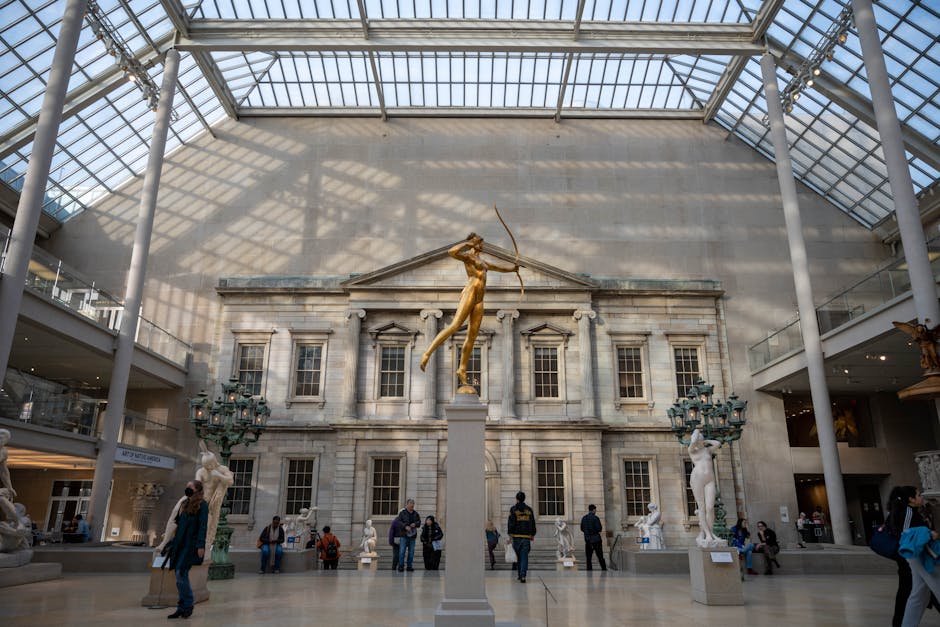
A coat-check ticket flutters from the hand of a young woman as she swaps her trench for a sequined shawl. The click of heels on marble echoes through the Great Hall as the crowds begin to gather. It’s Friday night, and The Met, that bastion of Fifth Avenue elegance, has thrown open its doors until the clock strikes nine, adapting a new rhythm that hums with possibility.
The scene is one of decadent juxtaposition. Here, a glass of chardonnay meets the stern gaze of an ancient pharaoh. There, a whispered conversation beneath the sprawling ‘Temple of Dendur.’ The Met’s late-night offering has become an unexpected hallmark of New York’s nightlife, drawing a crowd that would typically populate the dimly lit bars of SoHo or the clandestine loft parties peppering Tribeca.
Historically, museums have been preservers of the past, houses of solemn reverence. The Met by day is a tribute to this tradition—a cathedral to culture, where the hush of contemplation mingles with the scholarly gaze of its patrons. Yet, when the sun dips low and shadows stretch tall, a transformation takes place. The notion isn’t new. European institutions have dabbled in the art of twilight exhibitions, but here, on this very island, the endeavor feels like a revolution.
In the dimming light, something shifts. The strictures of day-time decorum loosen. The crowd is eclectic—students from NYU, a smattering of artists taking refuge from the city’s frenetic pace, and the occasional off-duty fashion editor whose day job dictates the whims of style. Among them, the lone security guard who patrols the Egyptian wing like a night watchman in a timeless tale. The Met at night is a living tableau, populated by characters as vivid as the works they come to observe.
Amidst the mingling of wine glasses and the shuffle of feet, there arises an air of irony. Nightlife, in the traditional sense, thrives on anonymity, on the collision of strangers in darkened rooms. But here, under the scrutinizing gaze of Vermeer and Van Gogh, it’s different. There’s no way to hide behind the abstraction of dim lights or pulsing beats. It’s a place where art doesn’t just hang on walls but springs to life in the interactions it provokes. There’s a vulnerability in confronting beauty with clarity—and it’s this vulnerability that draws so many each week.
not all are enchanted. The purists, those who lament the ‘commercialization’ of culture, see this as just another ploy to draw in the masses, a dilution of what they believe to be the sacred. At the bar, I meet a grizzled docent, his name lost to the night, who mumbles of ‘culture for culture’s sake,’ with a skepticism I can’t wholly dismiss. Yet, beneath his words is a begrudging nod to the vitality that pulses through these after-hours.
And then there are the ordinary New Yorkers. Take Carlos, a waiter from the Lower East Side, who’s never set foot in the museum by day. For him, the allure is simple: it’s a place to explore on his own terms. ‘I get off work, and I’m not ready to go home,’ he tells me, his eyes glancing towards a Rodin sculpture. ‘This city’s full of surprises—figured I might as well try one more.’
Perhaps that’s the essence of it. In a city where everything seems possible, why should a night at the museum be any different? As the final chime of the evening sounds, and the halls empty into the cool embrace of the evening air, we’re left with a singular thought: what does it say about us, that we crave these intersections of old and new? Of light and shadow? Maybe nothing. Or maybe, everything.
— Margaux Renier · Columnist

Leave a Comment