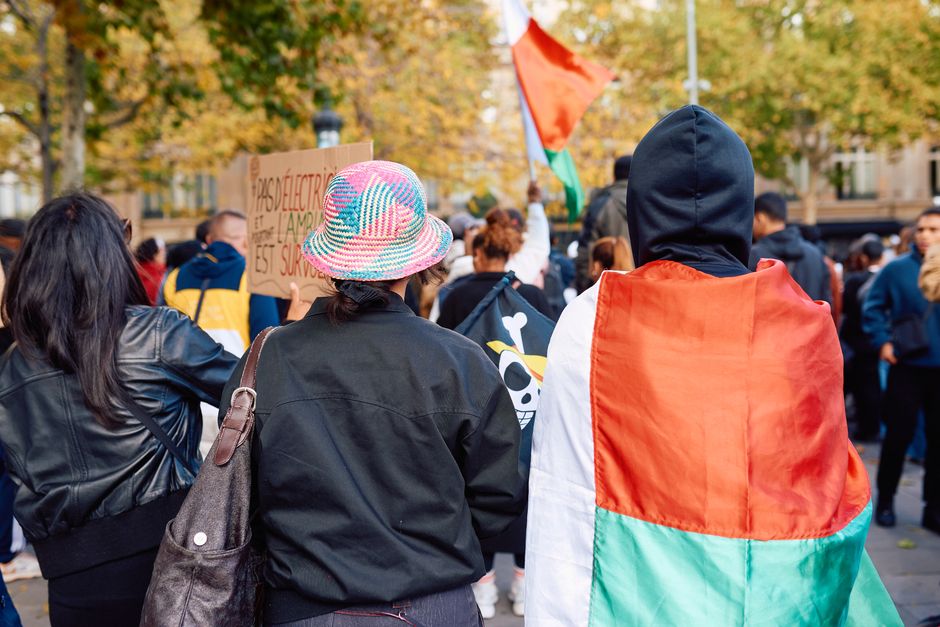
PARIS — Artists, culture workers and art students returned to the streets of Paris on Friday, October 24, a week after protests that left destruction in their wake and amid the preemptive closure of Art Basel Paris and museums including the Louvre, according to Hyperallergic.
Tens of thousands gathered at Porte d’Italie for a march called in part by Cultures en Lutte, a network of culture-sector coalitions that, per Hyperallergic, has mobilized alongside labor confederations and student unions since the movement began in mid-September. One of its driving forces is the National Union of Visual Artists (SNAP-CGT). The march, as the outlet describes it, was aimed in part at demanding a better life for artists.
The turnout came despite a week of official warnings. After the destruction of October 17, the French government announced what it called a “massive” security deployment, Hyperallergic reports. Under that plan, Sentinelle anti-terror soldiers would relieve police of guard duties, while special units would be backed by helicopters, armored vehicles and water cannons.
The previous Saturday’s protests drew far larger crowds. Reports estimate that more than 250,000 protesters turned out in Paris, with several hundred thousand more demonstrating around the country, according to the outlet. Police arrested approximately 1,000 protesters on Friday alone, Hyperallergic reports.
The scale of the shutdowns offers a measure of how seriously institutions took the threat of disruption. Art Basel Paris, one of the most prominent dates on the international art-fair calendar, and the Louvre, among the most visited museums in the world, were both closed ahead of the weekend’s demonstrations, per the source.
For New Yorkers who follow the art world, the images from Paris carry a familiar tension: a sector built on gallery openings, fairs and museum attendance now showing up in the street as a labor force with demands of its own. Hyperallergic’s account places artists and culture workers in the same column as labor confederations and student unions, rather than as bystanders to a broader political movement.
The source text does not detail the movement’s specific policy demands beyond the call for a better life for artists, nor does it describe what prompted the mobilization in mid-September. What it does establish is the pattern: a movement that began roughly six weeks ago, produced destruction on October 17, drew a heavy security response, and kept drawing crowds anyway.
Hyperallergic’s reporting, filed from Paris on the day of the march, captures a movement still in motion, with arrests mounting and the cultural sector now an organized part of it.
Frequently Asked Questions
Why did artists and culture workers march in Paris on October 24?
They marched from Porte d’Italie as part of a broader labor and student movement that began in mid-September, with the march called in part by Cultures en Lutte. The article says the march was aimed in part at demanding a better life for artists.
How many people protested in Paris on the previous Saturday?
Reports estimate that more than 250,000 protesters turned out in Paris, with several hundred thousand more demonstrating across the country. The article does not specify the exact date beyond it being the Saturday before the October 24 march.
Why were Art Basel Paris and the Louvre closed?
Both were closed ahead of the weekend demonstrations, following destruction on October 17 that prompted the government to announce a massive security deployment. The closures reflected how seriously institutions took the threat of disruption.
How many protesters were arrested in Paris on October 24?
Police arrested approximately 1,000 protesters on the Friday of the march alone, according to the article. The source does not provide arrest figures for other days.
Which organizations are behind the Paris artists’ protest movement?
The movement is organized partly through Cultures en Lutte and the National Union of Visual Artists (SNAP-CGT), working alongside labor confederations and student unions. The article notes the coalition has mobilized since mid-September.

Leave a Comment